
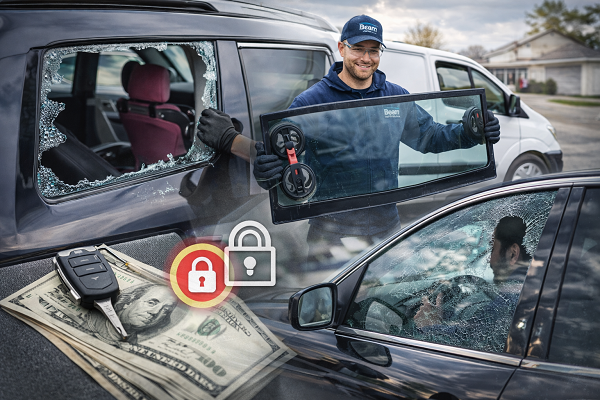
When most drivers think about auto glass damage, their minds immediately go to the windshield. However, Rear & Side Window Repair is just as critical to the structural integrity, safety, and security of your vehicle. At BEAM Auto Glass, we understand that a chip or crack in your quarter glass, rear window, or power window isn’t just an aesthetic nuisance—it’s a vulnerability. Whether caused by a break-in, a stray rock from the road, or thermal stress from a hot summer day, damaged side and rear glass compromises your visibility and puts you at risk. In this comprehensive guide, we will explore the common causes of side and rear window damage, help you navigate the repair versus replacement decision, break down the different glass types used in modern vehicles, explain why proper installation standards are non-negotiable, and demonstrate why professional service—the kind BEAM Auto Glass provides—is essential for correct fit and long-term safety.
Common Causes of Side and Rear Window Damage
Unlike windshields, which are designed to absorb impact and resist shattering, side and rear windows have different engineering priorities. Side windows are typically made of tempered glass, which is designed to break into small, pebble-like chunks upon impact to prevent lacerations. Rear windows may be tempered or, in some luxury vehicles, laminated glass similar to a windshield. This fundamental difference in composition makes them susceptible to distinct types of damage.
Vandalism and attempted theft remain the leading causes of side window replacement. A swift blow to a quarter glass or door window is often enough to grant entry. Environmental factors also play a significant role. Sudden temperature shifts—such as blasting the air conditioning on a scorching afternoon or pouring hot water over a frozen window—can induce thermal shock, causing tempered glass to fracture spontaneously. Road debris, while more commonly associated with windshields, can also strike side glass at highway speeds. Additionally, mechanical failure within the window regulator system can place uneven pressure on the glass, leading to cracks that originate from the edges.
Repair vs. Replacement: Making the Right Call
One of the most frequent questions we receive at BEAM Auto Glass is whether damaged side or rear glass can be repaired rather than replaced. The answer depends almost entirely on the location, depth, and type of glass.
For tempered glass found in most side windows, repair is rarely an option. Because the glass is heat-treated to withstand significant force before suddenly shattering, even a small chip compromises the entire panel’s structural integrity. Unlike a windshield, where resin can be injected into a bullseye crack to restore strength, tempered glass lacks the interlayer needed to hold a repair together. If a side window is chipped, cracked, or starred, it must be replaced.
Rear windows present a more nuanced scenario. Some modern vehicles utilize laminated glass for the rear windshield, particularly those with embedded antennas or defroster grids. If the damage is confined to the outer layer and does not exceed the size of a dollar bill or extend to the edge of the glass, a repair may be possible. However, any crack that reaches the edge of the rear window will inevitably grow due to vibration and thermal expansion. Similarly, damage that penetrates through to the inner layer or interferes with the defroster lines typically necessitates full replacement.
Understanding Automotive Glass Types
To appreciate why professional replacement is essential, one must understand the distinct characteristics of the glass itself. BEAM Auto Glass technicians are trained to handle both tempered and laminated glass with precision.
Tempered glass, used for virtually all side and some rear windows, is created through a process of extreme heating and rapid cooling. This creates a surface compression that makes the glass approximately four times stronger than annealed (standard) glass. When it does fail, it disintegrates into granular chunks rather than jagged shards—a deliberate safety feature designed to reduce injury. However, this same characteristic means it cannot be repaired.
Laminated glass, increasingly found in rear windows and some fixed quarter glass, consists of two panes of glass bonded to a polyvinyl butyral (PVB) interlayer. This construction provides superior sound insulation, UV protection, and structural rigidity. If broken, the glass adheres to the interlayer rather than showering the interior of the vehicle. Laminated glass is more forgiving of minor damage but requires specialized tools and adhesives for proper replacement.
The Critical Role of Installation Standards
Proper installation of rear and side glass is not merely about aesthetics or preventing wind noise. It is a safety-critical procedure. Side windows contribute to the structural integrity of the vehicle’s cabin, particularly in side-impact collisions. A window that has been improperly installed—or fitted with the incorrect type of adhesive—can dislodge upon impact, failing to keep occupants inside the vehicle and allowing intrusion from outside objects.
Furthermore, modern vehicles rely on precisely calibrated sensors and mechanisms. Rear windows often house defroster grids, AM/FM radio antennas, and even satellite radio or GPS receivers. Aftermarket glass must be compatible with these systems. Similarly, side windows interface with regulator mechanisms, weather stripping, and sometimes rain sensors. A replacement window that is one millimeter too thick or too thin can cause operational failure, water leaks, or excessive wind noise.
Industry standards, such as those set by the Auto Glass Safety Council (AGSC), mandate the use of OEM-equivalent adhesives and proper cure times. At BEAM Auto Glass, we adhere to the strictest safety protocols, ensuring that every replacement window meets or exceeds federal motor vehicle safety standards. For further reading on why certified installation matters, the Auto Glass Safety Council provides extensive resources on best practices and industry certification.
Why Professional Service Matters for Fit and Safety
Attempting a DIY side window replacement or entrusting your vehicle to an uncertified general repair shop often ends in frustration—or worse, compromised safety. The fitment of automotive glass is highly specific to each make, model, and year. A “universal” cut may fit the opening physically but fail to seal correctly, leading to leaks, corrosion, and eventual electronic failure within the door cavity.
Professional service providers like BEAM Auto Glass bring several advantages to the table. First, we source glass that matches the original equipment manufacturer (OEM) specifications. This ensures that tint levels, curvature, thickness, and embedded technology are consistent with the original design. Second, we employ trained technicians who understand the nuances of bonding times, primer application, and surface preparation. A window held in place by adhesive must cure undisturbed for a specific period; driving away too soon risks the glass ejecting from the frame.
Third, professionals carry appropriate insurance and warranties. When you choose BEAM Auto Glass, you receive a warranty on both the parts and the labor. Should an issue arise with the seal, the defroster performance, or the glass itself, we stand behind our work.
The BEAM Auto Glass Commitment
We believe that visibility is synonymous with safety. A pristine, properly fitted rear window gives you a clear view of traffic behind you. A smoothly operating side window ensures you can communicate with pedestrians, toll booth attendants, and drive-thru staff. More importantly, intact glass deters theft and protects you and your passengers from the elements and road debris.
Our process is designed for your convenience. We offer mobile service, arriving at your home or workplace equipped with the exact glass required for your vehicle. We handle the removal of broken glass, the preparation of the flange, the precise application of adhesive, and the installation of new glass with factory-spec alignment. We also recalibrate any sensors or defroster connections to ensure full functionality.
Conclusion
Your vehicle’s side and rear windows are not interchangeable with the windshield, nor should they be treated as an afterthought. They are engineered components with specific safety functions, from shatter resistance to occupant retention. Whether you are dealing with a smashed door window from a parking lot incident or a mysterious crack creeping across your rear glass, timely professional intervention is essential.
Do not compromise on fit, visibility, or security. Trust the experts who understand the nuances of tempered versus laminated glass, the importance of OEM specifications, and the critical nature of adhesive curing. For reliable, safety-certified Rear & Side Window Repair, contact BEAM Auto Glass today. Visit our website at to schedule a service or learn more about our comprehensive auto glass solutions. Your safety is our clear priority.


